Your thoughts have a direct effect on your reality - they maybe even create your reality.
This is a common concept in the self development space and it comes in many shapes and sizes. It’s most popularly known as The Law of Attraction and gained widespread attention in the 2006 film The Secret.
Chances are, you have an instant, knee-jerk reaction to this idea that’s either “yes, definitely” or “no, what nonsense”.
In this article, I want to examine the question: do your thoughts create your reality?
Instead of being simply for or against this idea, I want to examine it deeply and see what we can make of it if our primary interest is in practical, pragmatic life improvement.
I believe that within the idea of The Law of Attraction lies both potential danger and value. So, let’s unpack.
Asking the Right Question
Do I believe in manifestation, in the law of attraction?
That’s the wrong question to ask. If we take a close look at the writing around this topic, we can see that it is not a yes-or-no question.
Manifestation beliefs fall on a spectrum that goes from 100% yes to 100% no:
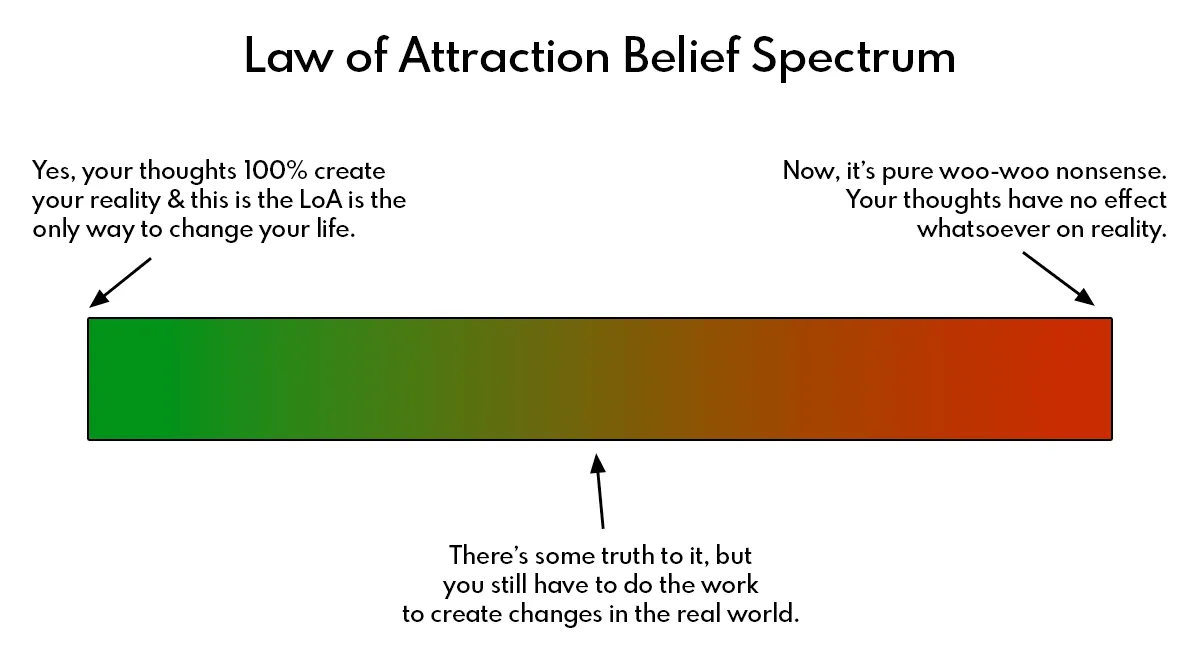
On the 100% yes side, we could summarize the belief as “your mind literally manifests your reality and it’s the only thing that matters - changing your mind is the only way to change the results you get”.
On the 100% no side, we’d have something like a naturalist belief: “your thoughts are just chemical processes in your brain and they have zero effect on the physical reality around you.”
Not many people fall onto either extreme end of this spectrum. You’re more likely to find someone who believes something like “manifestation is real, but you also have to do the work to get what you want.”
Instead of asking a yes-or-no question about the law of attraction, I think a better question is this one:
“What, if any, tangible effects do the state of your mind and the thoughts you think have on the real, external world around you?”
And we can simplify that a little to arrive at:
“Does your mind affect your reality? And if so, how?”
Let me try to lay out my answer to this question as clearly as I can:
Your Mind is Your Reality
Let’s get one thing out of the way: a person’s perception of reality takes place in the mind.
We don’t experience reality directly.
Instead, we perceive an interpretation of reality, based on sensory signals that reach the brain. We also know that a lot of what we perceive as reality is generated by our brains “filling in the blanks” and interpreting incomplete data (for example, we all have a blind spot in our vision, but our brain conveniently fills it in for us).
When I reach out and touch the side of my teacup, I’m not actually experiencing the objective reality of what’s going on.
At a glance, I recognize the object as a teacup and I have a whole bunch of memories associated with that. I’m getting an impression of heat, but at the same time, I’m not aware of countless other sensory information that is coming in through my nervous system. I had an expectation that the cup would be hot, so getting a sensory input of heat was unsurprising and didn’t lead to much other brain activity. Had the sensation been something unexpected like icy cold or spiky or oily, that would have kicked off a lot of additonal activity. All this activity is part of my reality, but it’s happening entirely inside my mind.
What you perceive as “reality” is really just brain activity. And a person standing right next to you, looking out at the exact same world has a slightly (or perhaps drastically) different experience of this reality, because their brain filters what it perceives through a different set of memories, associations and so on.
All this is to say: what we perceive as reality is a product of our minds.
And in that sense, yes, our thoughts affect our perceived reality. And we can indeed change our experience of reality by changing our mind.
However, none of this leaves the “inside my head” domain. We can acknowledge that our perception of reality is highly influenced by our thoughts and our mindset, but that doesn’t mean we create or influence the objective “out there” world with our minds.
But it does lead to something that I believe to be true and that I believe to be fundamentally important about the relation between thoughts and perceived reality: habits of mind.
Habits of Mind
At any given moment, there are nearly infinite things to perceive and thoughts to think. We’re always making a selection of some kind. If I’m thinking about what to have for dinner, that means I’m not thinking about an embarrassing mistake I made years ago. And vice versa.
If in this moment, I’m focused on how grateful I am for something positive in my life, it means I’m not focusing on something negative.
Because we’re only ever paying attention to and thinking about a tiny sliver of all possible inputs and thoughts, we have a huge amount of control over our perception of reality.
We can think of this as “practiced perception” and to explain it, I think gratitude exercises are a great example.
Example gratitude exercise: every evening, write down 3 unique things that happened this day, that you’re grateful for.
What happens when you do this?
Essentially, you’re giving your brain a task: “find at least 3 things to be genuinely grateful for, each day.”
You’re practicing asking and answering the question: what am I grateful for? What about this can I be grateful for?
Over time, as with anything you practice, you get better at this. You see more things you’re grateful for. You get better at finding aspects of something to be grateful for, even on an otherwise bad day.
And so you’re spending time seeing, thinking about and feeling gratitude, which means you don’t spend that time doing other (almost certainly more negative) things.
You’re building a new habit of mind and this habit is making your life more pleasant (incidentally, this particular habit may also make you happier, healthier and more successful).
You have a choice about what habits of mind you cultivate. You can get better at being grateful. You can get better at appreciating things deeply. You can get better at loving, valuing and appreciating other people.
It’s hard to overstate how much this changes your perceived reality. It can make the difference between living in a world full of misfortune and mean people or living in a world full of things and people to be grateful for.
Practiced perception applies to many other things too. You can get better at seeing good in other people, you can get better at reacting with calm and acceptance when something goes wrong, you can get better at looking for solutions instead of wallowing in problems and so on and so forth.
For a deeper dive into this idea, check out episode 28 of the ikario podcast:
So in this sense, your thoughts really do create much of your perceived reality. Your habits of mind are a critical component of what it’s like to live in “your world”.
BUT, here’s a really important distinction to draw: no matter what your perception of reality is doing, objective reality is still going on all around you.
Being an Effective Agent
Objective reality keeps doing its thing and and even if your thoughts have a great influence on your perception of it that doesn’t mean you can actually change it.
And this is where we bump up against a limitation when it comes to habits of mind and perception.
Most of us want to be an effective agent “out there”, in objective reality. We want to be able to live well, make shit happen, be free from suffering and all that. This is where we have to create some boundaries around what’s possible purely in the realm of perceived reality.
If the goal is simply to be happy, we could turn inwards and learn to be completely blissed out most of the time. This can be done through meditation and other introspective practices. It can be done via hypnosis, or using a wide variety of mind altering substances. Even just vivid daydreaming might do the trick. We could try to disengage from objective reality and simply be as happy as possible.
I think most people would agree that, even if you could be happy by means of pure self delusion or by ingesting mind-altering substances, something about that doesn’t seem right. Getting better at seeing the positive things in life seems like a good thing, but taking it to the point of total delusion does not.
Why is this?
Perhaps it’s because delusion makes us a less effective agent in the real world. The way this usually plays out is that people retreat into a positive mind-state until reality comes crashing down. For example, you can be blissed out on drugs for a while, but eventually you have to get some food, some movement, some sunlight. If you don’t, you suffer health consequences. And even if you ignore your deteriorating physical condition and keep escaping into drug-fueled bliss, eventually, you run out of drug money, you get kicked out of your home or your body succumbs and you die.
Eventually, the forces of objective reality catch up to you and overpower your ability to escape.
This is an extreme example, but the same principle applies to milder forms of delusion and escapism. Eventually, reality catches up.
It’s all a matter of dosage, of course. Certain delusional beliefs may make some parts of life easier to deal with and come with limited drawbacks in other ares of life. To most people, that’s a good tradeoff.
So is the solution to be 100% non-deluded and perceive the cold, hard truth of objective reality at all times?
Well, clearly not. Not least because we can never actually perceive objective reality. The human mind is not made to perceive or understand the full extent of reality.
So, here’s a different way of looking at it:
Your Mind as an Operating System
Your senses, your nervous system, your body and your brain are the “hardware” with which you navigate this world. Your mind, your beliefs and your world view are the “software”.
I like to think of the mind like an operating system. It’s a system for filtering and interpreting sensory inputs received by the hardware (and for controlling the hardware in turn).
There are all kinds of operating systems that you can use to control the same hardware. No one system is necessarily more “correct” than another, but some are vastly more effective than others. Some operating systems may suit your personal preferences and goals much better than others (think: Android vs iOS, Windows vs. Linux…).
You can pick and choose different beliefs, worldviews and thought patterns. You can cultivate different habits of mind. That’s like choosing what operating system to use and what software programs to run on it.
For me, the goal is to build an operating system that helps me navigate my world effectively, helps me achieve my goals and also maximizes my wellbeing.
And at this point, you’ve maybe noticed that something has snuck up on us: we are now talking about a key interaction between thoughts and objective reality.
Your thoughts, your operating system, determines how you interact with and behave in the world. And this, in turn, creates feedback because different actions lead to different outcomes.
So we are clearly at a point where thoughts have some sort of effect on objective reality.
Meet the Pygmalion Effect
In 1968, two psychologists ran an experiment on first-grade students and their teachers. The psychologists ran a newly developed evaluation test with the students and presented the results to the teachers. The test revealed that some of the kids were especially gifted and had a lot of hidden potential.
And they turned out to be right: in tests performed later on, the students that had been identified as especially gifted, did indeed outperform the other students of the class.
But, as so often with psychology studies, there was a hidden deception at play: the “gifted” students had actually been chosen at random.
So in reality, it wasn’t a special evaluation test that spotted the hidden potential in the kids. Rather, it was the changed expectation of the teachers that made a difference. Changed expectations meant that the teachers treated the supposedly “gifted” children differently and this led to a feedback loop that ultimately changed the students’ performance.
While the original study was widely criticized for being poorly designed, subsequent research has shown that the so called Pygmalion Effect is real. For example, a more recent study conducted by Ulrich Boser et al. found that:
“All else equal, 10th grade students who had teachers with higher expectations were more than three times more likely to graduate from college than students who had teachers with lower expectations. In other words, the expectations of teachers showed a very strong predictive relationship with college graduation rates.”
This is an example of something that starts entirely in the mind and goes on to affect objective “out there” reality. It’s a thought, an idea, an expectation of a student’s performance, which ultimately translates into a real-world change.
And it’s not hard to imagine how this might play out: the teacher‘s belief about the students will at first change the teacher’s behavior. Perhaps they give the “gifted” student extra attention, perhaps they encourage them more, push them harder and give them more challenging tasks.
This leads to a different experience for the student and it ultimately helps the student perform better.
And this kicks off a feedback loop - the increased performance of the student reinforces the idea that they’re talented, both in the teacher’s mind and in the student’s.
Self Fulfilling Prophecies & Other Feedback Loops
Feeback loops are a class of phenomena by which your thoughts affect your reality, including the objective „out there“ reality around you. The Pygmalion Effect and the placebo effect are such phenomena. And so is a self-fulfilling prophecy.
Here’s an example:
Imagine that you have to give a presentation. You’re nervous about it. Extremely nervous. You suffer from crippling self doubt and you’re convinced that people will boo you out of the room because they’ll dislike your presentation so much.
Given this belief, how do you think the presentation will go? Not great, most likely.
This is the feedback loop in action: you believe that you’ll fail horribly and this makes you appear nervous and lacking confidence. You’re uncomfortable and unhappy while giving your presentation. And, well, no one enjoys watching someone suffer nervously through a presentation. So indeed, your presentation will not be received well… and when you see the bored and sympathy-stricken faces in the audience, that just keeps making things worse.
The feedback loop goes the other way as well: if you are highly confident in your presentation and you believe you‘ll succeed, that makes you much more likely to actually succeed, because of how much more confidently you‘ll present your material.
That is a self fulfilling prophecy.
This phenomenon kicks in whenever your mental and emotional state have a direct and significant impact on your behavior and your behavior affects an outcome.
This is typically the case when there‘s an aspect of social interaction at play. What‘s more, there is a reinforcing feedback loop by which your success or failure confirms and strengthens your beliefs and these beliefs affect your future performance etc. (also known as vicious and virtuous cycles).
Another example of this class of phenomenon is athletic performance. If an athlete is tense, nervous and lacking in confidence, it can only make their performance worse. And their poor performance will further degrade their mental and emotional state.
This is why the “mental game” is such a key skill for any high level athlete - there is a feedback loop at play and a great athlete can create virtuous cycles and avoid vicious ones.
The Ripple Effect
I think it‘s reasonable to believe that these same kinds of feedback loops have more subtle effects as well.
Imagine this scenario: you feel tense and unhappy. As a result of this, every interaction you have during your day will be affected slightly. You‘re tense and impatient in your interactions with friends, family members, colleagues, even strangers like the cashier at a store.
In this negative state of mind, you have a meeting with a colleague. The conversation is uncomfortable for both of you - because of your state, it starts out in a poor way and the tension only grows as the meeting goes on.
Now, both you and the person you interacted with are leaving this meeting in a worse state than you entered it in. Perhaps their next meeting will go poorly because they’re feeling tense now, as well.
In this way, your mental and emotional states can ripple outwards.
And this ripple effect might even come back to you at a later date.
The next day, you feel better. You have another meeting scheduled with the same colleague. Unfortunately, their day hasn’t gone well and they’ve been dreading this meeting. The feelings from yesterday still linger.
Once again, you enter a meeting and essentially “infect” each other with stress and tension.
Like a butterfly effect, this could lead to lasting consequences. People expect interactions with you to be difficult and that makes them more likely to be difficult. Maybe they start avoiding you and act guarded around you. This, of course, feels bad for you and worsens your mood. You start to see evidence of people around you being unfriendly. You start to think they are the problem. And this makes your interactions with them worse still.
Of course we can also flip this around: if you‘re happy and relaxed, all those same interactions will be more pleasant and will be more likely to lift your mood further. People are drawn to you instead of repelled. You see evidence of people being friendly and kind.
I‘m painting an exaggerated picture here, but the point stands: ripple effects like this happen on a micro level, all the time. Your attitude ripples outward through every interaction you have. Over a lifetime, these micro ripples could accumulate to make a huge difference.
4 Levels of Effect
To summarize, we have identified 4 levels at which your mind affects your reality. These are:
- Internal: the way you perceive things is in part a matter of habit and your perceptions, thoughts and beliefs can have internal effects such as the placebo effect. Your internal state is also directly responsible for things like how happy you feel.
- Operating System: moving outward, your beliefs, world view, mental habits and mental models change how you see the world around you and how you navigate it.
- Feedback Loops: there are areas of life where feedback loops between your mental/emotional state and your real world results take place. Here, your thoughts, emotions etc. can affect your performance dramatically.
- Ripple Effect: in subtle and not-so-subtle ways your thoughts, beliefs and internal states affect other people. This in turn can change those people’s internal state and further “infect” more people. And these ripple effects can also come back to you in both positive and negative ways.
As you can see, I do indeed believe that your thoughts affect your reality and I can clearly define the ways in which it does and explain why.
This also means I can set a clear boundry between things that are and things that aren’t affected by your thoughts. And this is why I don’t believe in the Law of Attraction, as it is typically presented.
No Magic Required
Where my views greatly differ from the manifestation/Law of Attraction crowd‘s comes down to this: I don‘t think there‘s anything metaphysical going on.
If you want to „manifest“ more confidence, more happiness, better relationships or higher performance on the playing field, you might indeed succeed at doing so. Because in “manifesting”, you’re creating positive feedback loops (although it’s worth noting that this can also backfire).
But if you want a Ferrari in your garage, trying to directly manifest it is futile.
Let me be extra clear about why I believe this: it’s because there is no feedback loop between your beliefs about having a Ferrari in your garage and the actual contents of your garage.
This is where a proponent of the Law of Attraction is likely to start weaseling around the definitions of manifestation. E.g. “for the Law of Attraction to work you have to believe and you also have to go out there and do the work!”
However, if there is something metaphysical going on and manifestation is real, then I should be able to make a Ferrari appear in my garage by simply sitting in my room and doing the correct mental/emotional exercise.
And if that‘s not the case, if you‘re going to tell me that I need to do the manifesting AND go out into the world and do things to make more money and eventually buy a Ferrari, then what‘s the point? Why pretend that there‘s something magical going on if I still have to do all the non-magical stuff to get my Ferrari?
I’m not saying this in an attempt to dunk on Law of Attraction believers. I simply seek to refine my own understanding of what’s going on.
My thesis is that it all comes down to real-world action and mental/emotional states only play a role insofar as they create feedback loops.
Let’s consider the following thought experiment:
The Scientist, the Astrologer & the Android
Imagine that we have 3 test subjects, all with the exact same starting conditions. Think of each of these subjects as being in their own, parallel universe. They all have the exact same starting conditions and all of them have the same goal: a Ferrari in the garage.
Our first subject is the Astrologer. This subject has new age spiritual beliefs and will pursue his goal using only manifestation, using only the law of attraction in its purest form.
Our second subject is the Scientist. This subject does not believe in anything supernatural and will pursue the goal through real world action. The scientist tries to determine the best course of action as effectively as possible and then pursues that course of action. E.g. building a business, building a network, acquiring new skills and doing personal development work. The scientist’s goal is to create the circumstances by which he can earn enough money to eventually afford that Ferrari. This can include doing introspective work to increase confidence, to deal with limiting beliefs etc. But these are means to an end. The Scientist is not attempting to make a Ferrari appear in any supernatural way.
Finally, the third subject is the Android. The Android is a perfectly humanoid robot, indistinguishable from a real human. It looks and speaks and interacts exactly like a real human being. But it‘s a robot. It has no consciousness, it has no internal thought process or anything like it. Even when it appears to show emotions, those are just surface level actions, without any corresponding inner experience. The Android has no thoughts, no emotions, no goals, no dreams. It also has no intelligence. It is programmed to simply do one thing: it mirrors exactly all the actions that the Scientist takes. Down to the smallest detail, everything the Scientist does in his reality, the Android does in its reality (you can think of this as a highly complicated version of a Chess “bot” that simply copies a real player’s moves).
What outcomes would you expect in this experiment?
Here is the set of outcomes that I would bet on:
The Astrologer will not end up with a Ferrari in his garage.
The Scientist has a good chance of being able to buy that Ferrari, eventually. For the sake of simplicity: the Scientist does end up with a Ferrari in his garage.
And, crucially, I believe that the Android, our lifeless robot, will also end up with a Ferrari in the garage.
In other words: ultimately, it is your actions that matter. Your thoughts influence your reality to the extent that they influence your actions, in large and small ways.
The Case for Magic
At this point, I have a confession to make: I have personally had experiences that appeared magical. I have had experiences that strongly suggested to me that there must be something metaphysical going on, that what I’m experiencing cannot be explained by a normal course of events in a non-magical world.
But there’s a big difference between experiencing something magical and knowing that there is something magical going on.
You only need to go to a really good illusionist’s performance to experience this first hand.
Or take very strong drugs, perhaps.
To put it bluntly: the subjective experience of meeting god does not imply that god exists. It only implies that it’s possible to have a subjective experience that feels like meeting god.
In the same way that experiencing a “mind reading” trick done on you by a skilled illusionist does not imply that mind reading is possible.
Ultimately, I can’t prove that there’s ever been more going on than mental biases, feedback loops and randomness.
Extraordinary claims require extraordinary evidence. I have seen evidence, but not extraordinary evidence. This is why, despite my personal experiences, I don‘t see any reason to believe there‘s something magical going on with the mind affecting reality.
But let me be clear: in no way am I claiming to know the truth. I cannot make any claims about the ultimate nature of reality. Far be it from me to say anything like “this is exactly how the world works”.
The truth is: I don’t know. All I’m doing is reasoning and experimenting from my very limited vantage point.
But I do believe in good reasoning. And in my opinion, any productive conversation about manifestation, the law of attraction and other supernatural forces needs to start from a solid foundation. I’m not interested in (and admittedly have little patience for) vague claims about new agey beliefs, with little or nothing to back them up.
I’m interested to learn about people’s perspective on this, but if you talk about manifestation, let’s be crystal clear about the definition of terms we use. Let’s make a clear distinction between “objective reality”, “perceived reality”, thoughts affecting objective reality via feedback loops and other mind/reality interactions.
And please, don’t invoke quantum physics when your the most basic parts of your reasoning aren’t sound yet.
So this is an invitation to discussion, conversation, even debate. I just ask that you come well armed.
In Conclusion
If nothing else, what I‘ve laid out here has made for a highly effective operating system for me. Is this the whole truth and the precise truth about the nature of reality? Probably not. But it‘s an effective belief to operate from.
More than that, this set of beliefs doesn’t require mental gymnastics, it doesn’t trap you in a “believe harder” loop and it makes you quite resilient against charlatans and would-be gurus (who tend to manifest their Ferrari’s via their follower’s wallets).
I would say that’s reason enough to give it a shot. If you don’t like the software, you can always update it later.